
24/7 Customer Support

Free returns

Same-day & Next-day Delivery

Quality Guaranteed
Download the APP
Categories
Finding yourself tethered to a wall socket is a common frustration, whether you're working remotely from a café, studying in the library or catching up on emails during a long journey. A standard power bank might keep your phone alive, but modern laptops demand significantly more power. The search for a reliable laptop power bank can be confusing, with a maze of technical specifications like watts, milliamp-hours and charging protocols.
As a Joybuy Product Recommendation Officer, my role is to help you navigate these options. This guide is designed to provide clear, practical advice to help you find a portable charging solution that genuinely meets the needs of your high-power devices, without the marketing fluff. We will look at the key features to consider and highlight a few standout options for different users.
Before diving into specific products, understanding a few key technical details will empower you to make a more informed choice.
You will often see capacity listed in milliamp-hours (mAh), with a 20000mAh power bank being a popular choice for its balance of size and power. However, the more important figure, especially for air travel, is watt-hours (Wh). UK and international aviation regulations typically restrict carry-on batteries to 100Wh. The good news is that most high-capacity power banks, including those around 20,000mAh to 27,000mAh, are designed to be a flight approved power bank by staying under this 100Wh limit. Always check the Wh rating printed on the device before you fly.
The wattage (W) of a power bank determines how quickly it can charge your devices. A standard phone charger might offer 15-20W, but a laptop requires much more. To effectively charge a notebook, look for a USB C laptop charger with an output of at least 45W-65W.
For more demanding machines, such as a high-performance Dell XPS or a MacBook Pro power bank, you should consider a 140W portable charger. These often feature the latest PD 3.1 fast charging protocol, a standard designed to deliver significant power safely and efficiently to compatible devices, drastically reducing charging times.
Consider how many devices you need to charge simultaneously. Most modern laptop power banks come with multiple ports, typically a mix of USB-C for high-power delivery and USB-A for legacy devices. A power bank with display is another increasingly common feature. This small screen provides real-time information on the remaining battery percentage, charging speed and estimated time until full, taking the guesswork out of power management.
Here are a few laptop power banks that offer a compelling combination of performance, capacity and features for professionals, students and travellers.
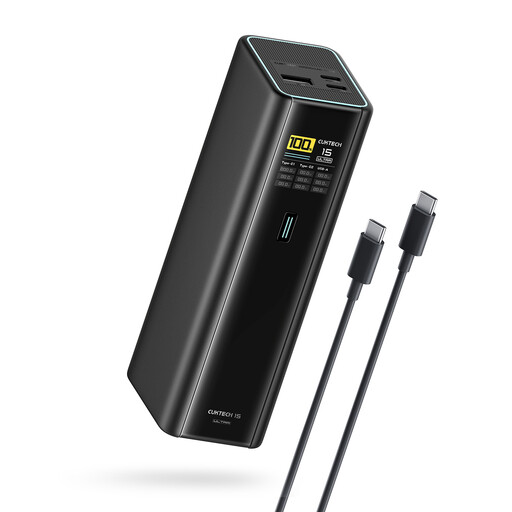
Why It Stands Out: The CUKTECH 15 Ultra is built for those who need maximum power on the go. Its standout feature is the 140W single-port output, enabled by the PD 3.1 fast charging standard. This makes it one of the few portable chargers capable of charging high-performance laptops, like the 16-inch MacBook Pro, at or near their full charging speed. The 20,000mAh capacity provides a substantial power reserve, while its three ports allow for versatile charging of multiple devices at once.
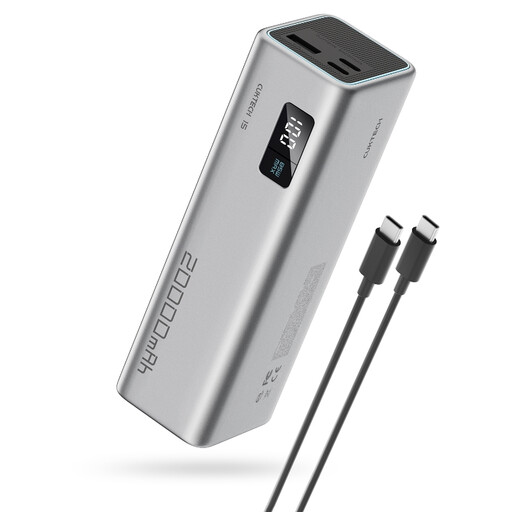
Why It Stands Out: The CUKTECH 15 SE offers a more balanced approach, providing ample power for the majority of mainstream laptops in a practical package. Its 65W single-port output is more than sufficient for charging devices like a MacBook Air, Dell XPS 13 or HP Spectre. It shares the same 20000mAh power bank capacity as its "Ultra" sibling and features three ports, but at a more accessible price point. It also includes a low-current mode for safely charging smaller accessories like wireless earbuds or smartwatches.
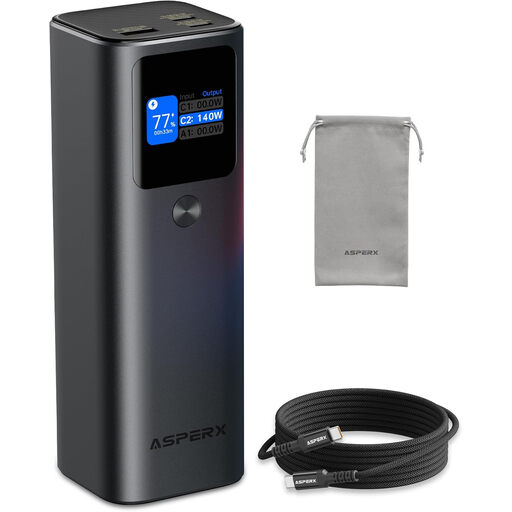
Why It Stands Out: The AsperX power bank pushes the limits of what a flight approved power bank can offer. With a capacity of 27,600mAh (rated at 99.36Wh), it maximises the allowable energy for air travel. Its total output of 162.5W is impressive, capable of delivering up to 140W from a single port or powering two laptops simultaneously at 65W each. What sets it apart is its premium aluminium unibody construction for better heat dissipation and a large, colourful TFT power bank with display that provides detailed, real-time charging statistics.
The models highlighted here represent some of the most capable choices available, but the world of portable power is vast. If you're looking for different capacities, form factors or specific features, there are many other excellent solutions to explore.
️ Discover more options in our Notebook Charger category
1. Can I take a 20000mAh power bank on a plane in the UK? Yes, you can. Aviation authorities regulate batteries based on their energy rating in watt-hours (Wh), not just milliamp-hours (mAh). The limit for carry-on luggage is 100Wh. A typical 20000mAh power bank is rated at around 74Wh, which is well under the limit, making it a safe and common choice for a travel battery pack.
2. How many times can a 20000mAh power bank charge a laptop? This depends on two factors: the battery size of your laptop and the efficiency of the power bank. Due to energy loss during power transfer (usually around 20-30%), a 20000mAh power bank will not deliver its full capacity to your device. As a general rule, it can provide approximately one full charge for an ultrabook (like a MacBook Air) or about 60-80% for a larger, high-performance laptop (like a MacBook Pro 16-inch).
3. What wattage do I need in a laptop power bank? The simplest way to determine this is to check the wattage of the original charger that came with your laptop. This figure is usually printed on the power brick. For most standard laptops and ultrabooks, a 45W or 65W output is sufficient. For more powerful workstations or gaming laptops, you will need a charger with a 90W, 100W or even 140W output to charge effectively, especially while the device is in use.